safeledger logo
Vat Registration

How to Register for VAT in UAE for a New Company​?

Reading Time7 min read
How to Register for VAT in UAE for a New Company​?

Table of Contents

Starting a new company in the UAE comes with many responsibilities, both operational and legal. One of the most important requirements is VAT (Value-Added Tax) compliance. Understanding how to register for VAT in UAE for a new company is extremely crucial as it applies to most goods and services supplied. The UAE government introduced Value Added Tax (VAT) on January 1, 2018, at a standard rate of 5%.

New businesses must register with the Federal Tax Authority (FTA) if their taxable supplies exceed AED 375,000 per year. Businesses with a turnover between AED 187,500 and AED 375,000 can also register voluntarily.

Registering for VAT allows your business to collect VAT on sales and claim VAT on purchases. It also ensures you operate without legal penalties.

This blog offers a step-by-step guide for new companies to register for VAT in the UAE, covering eligibility, documents, fees, and common mistakes.

What is  Value Added Tax (VAT) in the UAE?

Value Added Tax (VAT) is a consumption tax applied to most goods and services in the UAE. VAT is collected at every stage of the supply chain. Businesses charge VAT on their sales (output tax) and reclaim VAT on eligible purchases (input tax). This ensures the final tax burden falls on the end consumer.

For new companies, VAT registration and proper compliance affect pricing, accounting, and cash flow management. Managing VAT correctly helps you set accurate prices, issue valid VAT invoices, and maintain records. This reduces the risk of fines from the Federal Tax Authority (FTA).

Who Can Apply for VAT Registration for a New Company? Eligibility Criteria

Before registering for VAT in the UAE, a company must meet the eligibility requirements set by the Federal Tax Authority (FTA). Meeting the following criteria ensures your application is accepted and your business operates legally under UAE tax laws:

  1. Annual Taxable Supplies Threshold: Businesses must have taxable supplies and imports exceeding AED 375,000 per year to qualify for VAT registration. Taxable supplies include all goods and services subject to the standard 5% VAT rate. Companies must register before they issue any VAT invoices.

Example: If your company supplies goods worth AED 400,000 per year, VAT registration becomes mandatory.

  1. Voluntary Registration Criteria: Companies with annual taxable supplies between AED 187,500 and AED 375,000 can opt for voluntary VAT registration. This allows smaller or new businesses to:
  • Issue VAT-compliant invoices
  • Reclaim input VAT on business purchases
  • Build credibility with other VAT-registered companies
  1. Business Location: Your company must be physically or virtually established in the UAE to register for VAT. Businesses operating from free zones, mainland offices, or virtual setups can register as long as they meet the taxable supply thresholds. Some free zones may require additional approvals before registration, especially when dealing with VAT in free zone rules and exemptions.
  2. Valid Trade License: A valid UAE trade license is mandatory for VAT registration. The license confirms your business type, scope, and legal status. The FTA uses it to process your VAT registration application.
  3. Accurate Financial Records: Businesses must maintain accurate accounting and bookkeeping records, including sales invoices, purchase receipts, and import/export documents. The FTA will require these records during registration and ongoing VAT compliance. Using a digital accounting system can simplify record management.

Compliance allows new businesses to claim input VAT, issue valid invoices, and maintain financial transparency, laying a strong growth foundation.

How to Register a New Business for VAT in the UAE?

Registering a new business for VAT in the UAE, as defined by the Federal Tax Authority (FTA) follows a structured process. Here’s a detailed, step-by-step guide for new companies to complete VAT registration efficiently:

Step 1: Create an FTA Online Account

New companies must register on the FTA e-Services portal (eservices.tax.gov.ae) for those completing business setup in UAE.

  • Use a valid company email and phone number.
  • Enter accurate company details as per your trade license.
  • The account allows you to manage VAT filings, payments, and notifications.

Step 2: Fill Out the VAT Registration Form

Complete the online VAT registration form carefully:

  • Enter company details, business activities, and taxable supply estimates.
  • Add partner/shareholder information accurately.
  • Double-check entries to avoid mistakes that can delay approval.

Step 3: Submit Required Documents

Upload all collected documents to the FTA portal:

  • Ensure files are clear, legible, and correctly formatted.
  • Include all mandatory and optional supporting documents.
  • The FTA verifies these documents to confirm your company’s eligibility.

Optional: Submit Power of Attorney if a consultant handles registration.

Step 4: FTA Verification

After submission:

  • The FTA reviews your application and documents.
  • You may be contacted by FTA for additional information if needed.
  • Verification usually takes 1–3 working days.

Step 5: Receive VAT Registration Certificate

Once approved:

  • The FTA issues your VAT registration certificate.
  • You receive your VAT TRN (Tax Registration Number).
  • Your company can start charging VAT on supplies and reclaiming VAT on eligible purchases.

Tip: Keep digital and physical copies for audits and official use.

Step 6: Start VAT Compliance

After registration, your company must:

  • Issue VAT-compliant invoices for all taxable supplies.
  • File regular VAT returns (monthly or quarterly, as applicable).
  • Maintain accurate accounting records for VAT audits.

Total Estimated Time: 3–7 working days (if all documents are complete and correct).

For stress-free VAT registration for your new company in the UAE, trust SafeLedger. Our experts ensure accurate document submission, smooth FTA verification, and full compliance.

Documents Required for VAT Registration for New Company in the UAE

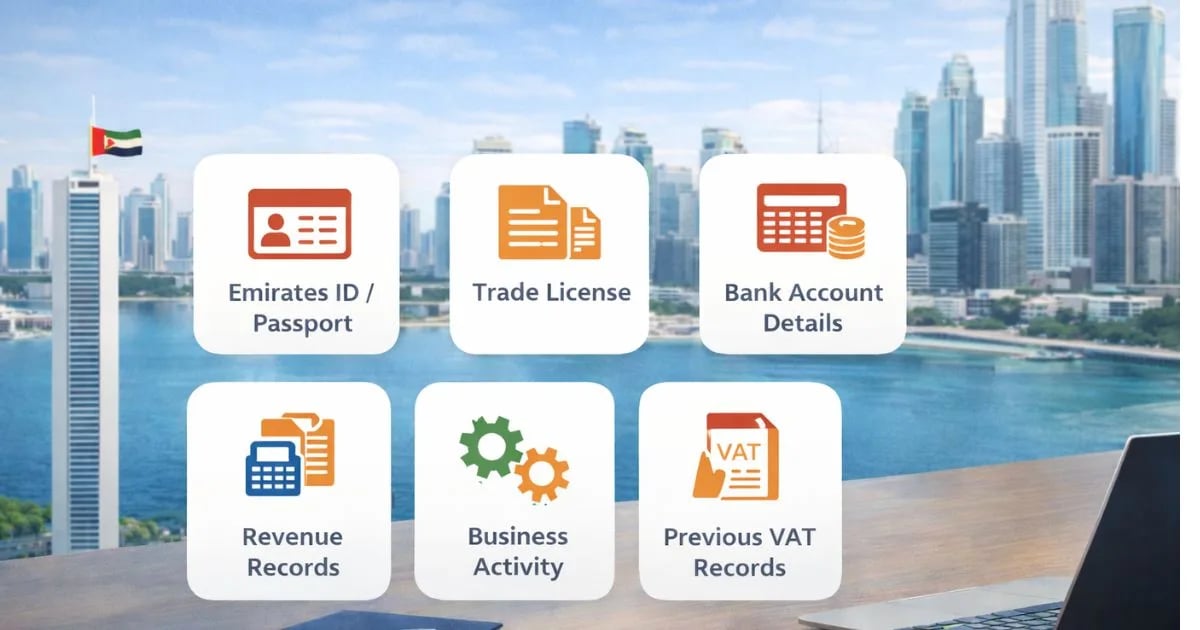
To complete VAT registration for a new company in the UAE, you must submit specific documents to the Federal Tax Authority (FTA).

Here are the essential documents that new companies need to prepare before applying for VAT:

  1. Valid Trade License: A copy of your UAE trade license is mandatory. This document confirms your business type, scope, and legal status. The FTA uses it to verify that your company is legally permitted to operate in the UAE.
  2. Passport Copies of Partners or Shareholders: Provide passport copies of all partners or shareholders. This allows the FTA to verify ownership and identify the company’s authorized signatories.
  3. Emirates ID of Partners or Shareholders: For UAE residents, Emirates IDs of all partners or shareholders are required. These IDs prove residency and legal identity for VAT registration.
  4. Bank Account Details: Submit UAE corporate bank account details after you open a bank account in the UAE. The FTA uses this information to process refunds, handle VAT payments, and communicate securely regarding financial transactions.
  5. Contact Information: Provide your company’s official email address, phone number, and physical address. Accurate contact details ensure you receive notifications, reminders, and VAT-related correspondence from the FTA.
  6. Additional Documents (If Applicable):
  • Power of Attorney (PoA) if a consultant or tax agent is submitting the application.
  • Additional approvals for free zone licenses.

Having all documents ready lets your company register for VAT smoothly and start operations fully compliant in the UAE.

VAT Registration Costs for New Company in the UAE

When planning to register a new company for VAT in the UAE, business owners often wonder about the costs involved. The good news is that the Federal Tax Authority (FTA) does not charge any registration fee. You can apply directly through the FTA e‑Services portal at no cost.

However, businesses may incur costs for professional support, accounting software, compliance services, and penalties if deadlines are missed.

Below is a detailed cost breakdown to help new companies plan their VAT budget accurately:

Cost ComponentWhat It CoversEstimated Cost (AED)
FTA Registration Fee Official government VAT registration 0 (free)
Consultant/Tax Agent Fees Professional assistance with registration, documentation & submission 1,500 – 5,000 (varies by complexity)
Document Preparation Fees Review and compile required documents 500 – 1,500
Accounting Software Setup Software purchase/setup for VAT invoicing & compliance 500 – 8,000
VAT Certificate Attestation (Optional) Attestation of the VAT certificate for legal use 250 – 500
Free Zone Approvals (Optional) Additional fees for some free zone authorities 500 – 2,000+
Penalty — Late VAT Registration If registration is delayed beyond the 30-day threshold 10,000
Late VAT Return Filing (First Offense) Missing filing deadlines 1,000 – 2,000
Late VAT Payment Penalty Delayed or unpaid VAT 2% of unpaid VAT + 4% per month, up to 300% of the due VAT
Incorrect VAT Return Penalty for inaccuracies 3,000 – 5,000

VAT registration is free, but costs may arise for support or penalties. SafeLedger ensures smooth registration, accurate filings, and avoids costly mistakes.

Why Choose SafeLedger for VAT Services in UAE?

SafeLedger provides complete VAT registration and compliance support for new companies in the UAE, covering Dubai and other emirates. These services are part of its broader Business Compliance Services in the UAE.

  1. Accurate Documentation & Compliance: SafeLedger carefully reviews all your VAT registration documents, ensuring they meet FTA standards and reducing the risk of delays or rejections.
  2. Expert Guidance for New Companies: Whether you are a mainland LLC, free zone startup, or partnership, SafeLedger provides clear guidance on eligibility, required documents, and registration steps.
  3. Time-Saving & Convenient Process: By managing document preparation, online submission through the FTA e‑Services portal, and follow-ups, SafeLedger saves you time. You can also easily track your application progress.
  4. Cost Transparency: SafeLedger provides clear estimates for consultancy fees, software setup, and optional services upfront. There are no hidden charges, allowing you to budget confidently.
  5. Fast & Reliable Support: From answering queries to monitoring your application status, SafeLedger ensures timely support throughout the VAT registration and compliance process.

Contact SafeLedger today to start your VAT registration smoothly and avoid delays or penalties.

Frequently Asked Questions

Yes, if your company’s taxable supplies and imports exceed AED 375,000 over the past 12 months or will exceed it in the next 30 days, you must register for VAT with the Federal Tax Authority (FTA). You need to submit the application within 30 days of meeting this threshold to avoid late-registration penalties. Early registration ensures smooth compliance and prevents unnecessary fines.

Taxable supplies include goods and services subject to the standard 5% VAT rate. Imports that would be taxable if supplied locally also count toward the threshold. You must include these supplies when calculating turnover to determine whether VAT registration is mandatory. Properly including all taxable supplies helps new companies avoid errors and ensures timely registration without risk of penalties.

Yes, if your taxable supplies, imports, or expenses exceed AED 187,500 over the past 12 months or are expected to within the next 30 days, you can register voluntarily. Voluntary registration allows new companies to charge VAT, reclaim input tax on purchases, and issue compliant VAT invoices even before reaching the mandatory threshold, boosting credibility with clients and suppliers.

After submitting your VAT registration application on the FTA e‑Services portal, you will receive your VAT registration certificate once approved. This certificate includes your Tax Registration Number (TRN), which you can immediately use for invoicing and compliance. Keeping both digital and printed copies ensures your company can operate VAT-ready without delays and maintain records for audits.

If you delay VAT registration beyond 30 days of exceeding AED 375,000 in taxable supplies or imports, the FTA can impose late-registration penalties. Penalties depend on how late you register and the VAT collected. Timely registration prevents unnecessary costs and maintains legal compliance, ensuring your new company can start operations VAT-ready and avoid fines.

Yes, non-resident businesses supplying taxable goods or services in the UAE must register for VAT even if turnover is below AED 375,000, unless another UAE party is responsible for VAT. Registration ensures compliance, allows input VAT recovery on eligible purchases, and avoids penalties for failing to register while operating within the UAE market.

No, you can only reclaim input VAT after your VAT registration is officially approved and your company receives its TRN. Purchases made before approval do not qualify for input tax claims. Registering early ensures your new company can recover VAT on eligible expenses from the start, improving cash flow and compliance efficiency.

Yes, even if your business exports services that are zero-rated, these supplies still count toward the VAT registration threshold. You must register for VAT if total taxable and zero-rated supplies exceed the mandatory threshold. Registration ensures compliance and allows you to claim input VAT on business purchases related to exports.

Yes, after registering, you must maintain accurate records of all sales, purchases, invoices, and import/export documentation. These records support correct VAT return filing, enable smooth audits, and ensure your company meets FTA compliance requirements. Using digital accounting systems can simplify record management and minimize errors for new businesses.

Yes, if your company no longer meets mandatory or voluntary registration criteria, you can apply to de-register VAT through the FTA portal. You must settle all outstanding VAT liabilities before approval. Once de-registered, your company no longer files VAT returns but must maintain records for prior periods, ensuring compliance and a clean exit from VAT obligations.

VAT registration in the UAE is usually processed quickly through the FTA e‑Services portal. Once you submit a complete application with all required documents, the Federal Tax Authority typically reviews and approves it within 3 to 10 business days. After approval, you immediately receive your VAT registration certificate and Tax Registration Number (TRN), which you can use for invoicing and compliance. Early submission ensures smooth operations and avoids delays in starting VAT‑compliant activities.

Just Drop Your Info Below We’ll Get In Touch With You

Joel Dsouza

About the Author

Joel Dsouza

Joel Dsouza is a Chartered Accountant and compliance specialist with extensive experience advising over 1,000 startups and SMEs on company registration, tax structuring, and regulatory compliance. As a member of ICAI and Co-Founder of Safe Ledger, Joel combines his deep financial expertise with a global perspective to help entrepreneurs navigate complex business environments. Focused on the UAE market, he is dedicated to empowering international and local business owners with clear, practical guidance on company setup, tax optimization, and ongoing compliance making him a trusted advisor for businesses aiming to succeed in the dynamic UAE economy.

Related Posts

View All
WhatsApp Icon