safeledger logo

Cost of Emirates ID: Application, Renewal, and Fines

Reading Time7 min read
Cost of Emirates ID: Application, Renewal, and Fines

Table of Contents

An Emirate ID serves as official proof of identity for citizens and residents in the UAE. Most sectors in the UAE, including banking, employment, healthcare, telecom, and the public sector, require it mandatorily. Understanding the cost of the Emirates ID is essential, as it is closely tied to the duration of the residence visa in the UAE. This factor can directly impact the total of an Emirate ID in the UAE.

This guide explains Emirates ID charges in the UAE, covering application fees, renewal fees, and late fines. The blog also compares costs based on visa validity and shares practical tips to reduce expenses and stay compliant.

What is an Emirates ID in UAE?

The Emirates ID is an official identity card issued by the UAE government authority, “Federal Authority for Identity, Citizenship, Customs and Port Security (ICP)”. The card is mandatory for all UAE citizens and residents as it serves as legal proof of identity and residency across the UAE.

Both UAE citizens and residents receive an Emirates ID, but their legal status is not the same. The difference mentioned below affects how the Emirates ID applies to each group:

  • UAE citizens hold nationality and receive long-term Emirates IDs.
  • UAE residents are foreign nationals living in the country on a residence visa. The Emirates ID validity depends on the duration of their visa.

Why do you need an Emirates ID in the UAE?

People use the Emirates ID across Dubai, Abu Dhabi, and other emirates as a universal form of identification. It is required for various activities in the UAE, including:

  • Business Setup in the UAE: Authorities require an Emirates ID for business setup in the UAE because it serves as official proof of your identity and legal residency.
  • VAT Registration: To register VAT in the UAE, the Federal Tax Authority (FTA) requires your Emirates ID to confirm your legal residency in the UAE.
  • Business License Registration: A valid Emirates ID is required to obtain a business license. The Department of Economic Development (DED) needs it to verify the applicant’s legal identity
  • Virtual Office Registration: Setting up a virtual office in the UAE requires the Emirates ID to verify that the applicant is a legitimate UAE resident authorized to register the business.
  • Trademark Registration: For trademark registration, an Emirates ID is required to verify the applicant’s identity.

Almost all government activities require official identity proof for verification. This makes the Emirates ID card an important document in the UAE.

Emirates ID Card Fees Structure: Cost Breakdown

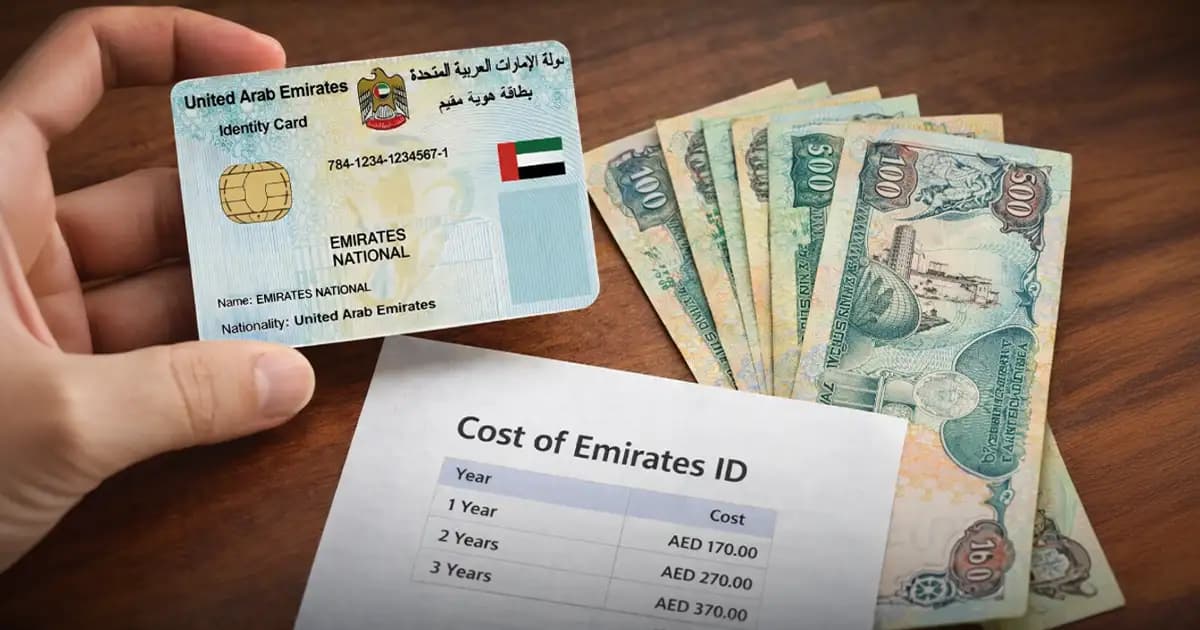
It usually costs AED 160 to AED 420 to get an Emirate ID card in the UAE. The total fees depend on various charges, including base, service & application fees. Understand in detail the various costs associated with the Emirates ID and how they differ based on your citizenship.

  1. Base Card Fees

The base Emirates ID fee is the amount charged by the government for issuing the card. This fee depends on the validity of the Emirates ID.

1.1 For UAE residents (expatriates)

The Emirates ID validity always matches the residence visa period. As a result, the ICP calculates the base Emirates ID fee at approximately AED 100 per year of ID validity.

For example, a 2-year visa requires a one-time base fee of around AED 200, while a 3-year visa costs around AED 300.

Use PRO services in the UAE to apply for seamless visa renewal and avoid dealing with the confusing renewal laws.

1.2 For UAE citizens and GCC nationals

The Emirates ID for UAE citizens and GCC nationals is not tied to a visa. Instead, the ICP issues the card for fixed validity periods, usually 5 years or 10 years. Each option comes with a fixed base fee, regardless of yearly breakdown.

  1. Service and Application Fees

In addition to the base fee, applicants also pay service and application charges. These fees vary based on how and where you apply.

Applications submitted online through ICP (smartservices.icp.gov.ae) or UAE Pass (uaepass.ae) are usually less expensive. Applications processed through typing centers include additional service charges. These fees typically range from AED 50 to AED 100, depending on the center and location.

  1. Total Typical Costs by Category

The total Emirates ID cost depends on the base fee, service charges, and typing center fees. Below is a breakdown of the estimated ID cost for 2025-2026, based on standard ICP charges:

CategoryValidityApprox Total Cost (AED)
Expat Resident 2 years 270-310 AED (Approx.)
Expat Resident 3 years 370-410 (Approx.)
UAE Citizen 5-10 years 170-310 (Approx)

These are estimated amounts; the final cost may vary depending on the application method and Visa service provider.

Note: These costs are not fixed; they may vary depending on residency status, application method, and ICP regulations.

  1. Emirates ID and Visa Renewal Costs: Combined Fee Breakdown

Here are the typical total costs you might expect when renewing both the visa and Emirates ID together:

ComponentEstimated Cost (AED)
Residence visa renewal AED 500-AED 1,200
Emirates ID renewal (basic) AED 100 per year of visa validity
Medical fitness test AED 300-AED 500
Typing/processing services AED 50-AED 150
Typical total for 2-year renewal  AED 900-AED 1,800 (visa + ID + medical + services)
Typical total for 3-year renewal  AED 1,100-AED 2,100 (longer visa + ID + medical + services)

These rough cost estimates help with planning, but they may vary based on visa type, emirate, medical tests, and the chosen service method.

Additional Emirates ID-Related Costs in Dubai and the UAE

In addition to the standard application and renewal fees, the following additional Emirates ID prices may apply in specific situations:

  1. Replacement Fees for Lost or Damaged ID: If you lose or damage your Emirates ID, you must apply for a replacement. The replacement fee includes a government charge and processing fees. The price is higher for lost cards compared to damaged ones. Additional typing center or service charges may also apply.
  2. Urgent or Fawri Service Charges: Applicants who need the Emirates ID urgently can choose the Fawri or express service. This option allows faster processing, often within 24 hours. The service comes with an extra fee, charged on top of the normal Emirates ID cost.
  3. Late Renewal Penalties: If you fail to renew the Emirates ID on time, the authorities apply a daily fine. The penalty usually starts at AED 20 per day after the grace period and can reach a maximum of AED 1,000. Renewing on time helps avoid unnecessary penalties and service disruptions. ICP allows a grace period (usually 30 days) after visa expiry to renew the Emirates ID without penalties.

Follow the UAE government’s guidelines to avoid delays, additional expenses, or penalties. Take professional assistance from SafeLedger to avoid delays and penalties.

How to Pay Emirates ID Fees in the UAE?

You can pay Emirates ID fees personally or through an authorized Power of Attorney in the UAE. You can make the payment through the following approved channels:

  • Online via ICP or UAE Pass: You can pay the fees online via the ICP or the UAE Pass. For these online payments, the system issues digital receipts instantly.
  • Typing Centers: Authorized typing centers assist with form submission and fee payment. They charge an additional processing fee.
  • Customer Happiness Centers: ICP Customer Happiness Centers accept applications and payments directly. Staff assist with biometric capture and verification.

Tip: Always keep payment receipts for reference and use the UAE Pass where possible to reduce service fees.

What is the Difference Between Visa Expiry and ID Expiry?

Many residents in the UAE often confuse visa expiry with Emirates ID expiry, but they are two separate things. The table below clearly explains the difference between the two:

FeatureVisa ExpiryEmirates ID Expiry
Definition Legal permission to live and work in the UAE Official government-issued identity card
Issued By UAE Immigration / Visa authorities Federal Authority for Identity, Citizenship, Customs & Port Security (ICP)
Purpose Confirms your residency and visa status Serves as proof of identity and residency
Effect of Expiry Loss of legal residency; risk of fines or deportation Daily fines (AED 20/day, up to AED 1,000); restricted access to services
Renewal Dependency Must be renewed first for residents Cannot renew without a valid residence visa for expats
Services Affected Employment, residency legality, and visa-related processes Banking, government services, healthcare, SIM registration, and official transactions
Validity 1–3 years for most residents; 5–10 years for golden visas Matches residence visa for residents; 5–10 years for citizens

For accurate budgeting and transparent pricing for both aspects, contact SafeLedger. We help you manage Emirates ID and visa renewals with clarity and accuracy. Our experts guide you on costs, timelines, and compliance to help you avoid delays and fines.

Frequently Asked Questions


The cost of an Emirates ID in the UAE varies depending on the applicant’s status and the validity period. For expat residents, the base fee is around AED 100 per year of visa validity, calculated for the full duration of the visa and paid once at the time of application or renewal. In addition to the base fee, applicants may need to pay service charges if applying through typing centers or for express services. Other factors, such as the application method (online vs. in-person), can also slightly affect the total fee.

While the Emirates ID is not entirely free, the government provides significant subsidies for citizens. UAE citizens pay a fixed, low fee for IDs with 5-year or 10-year validity. This ensures long-term access to government and private services without imposing high costs. Citizens do not pay per year like residents; the fee covers the entire validity period. This subsidy encourages citizens to maintain updated IDs and ensures nationwide compliance without financial burden.

Many employers cover the cost of the Emirates ID as part of the residence visa sponsorship process. This typically includes the base fee and any related service or processing charges. Companies often handle applications or renewals to ensure timely compliance. However, the policy may vary depending on the employer. In some cases, the employee may need to pay extra service fees if opting for urgent processing or applying through private typing centers.

If your Emirates ID expires, you lose access to many essential services in the UAE. Banks may block your accounts, healthcare services might be limited, and government portals like UAE PASS or ICP services may become inaccessible. You will also be liable for late renewal fines, usually AED 20 per day, up to a maximum of AED 1,000. Renewing your ID promptly ensures uninterrupted access to all services.

No, you cannot use an expired Emirates ID for domestic or GCC travel. Airlines, border authorities, and government checkpoints require a valid Emirates ID or passport. For residents, the ID is tied to your residence visa, so traveling without a valid ID may lead to fines or denied entry back into the UAE. Always renew your Emirates ID before it expires if you plan to travel.

Yes, every child in the UAE, including newborns, must have an Emirates ID. Children under 15 are issued an Emirates ID under the supervision of their parents or guardians. The card serves as proof of identity and residency for government services, healthcare, and educational purposes.

Generally, residents cannot renew their Emirates ID without renewing their residence visa, as the ID’s validity is tied to the visa. For UAE citizens, ID renewal is independent of visa status, so they can renew their ID based on their ID expiry date. For residents, planning ID renewal alongside visa renewal ensures compliance and avoids fines.


Just Drop Your Info Below We’ll Get In Touch With You

Joel Dsouza

About the Author

Joel Dsouza

Joel Dsouza is a Chartered Accountant and compliance specialist with extensive experience advising over 1,000 startups and SMEs on company registration, tax structuring, and regulatory compliance. As a member of ICAI and Co-Founder of Safe Ledger, Joel combines his deep financial expertise with a global perspective to help entrepreneurs navigate complex business environments. Focused on the UAE market, he is dedicated to empowering international and local business owners with clear, practical guidance on company setup, tax optimization, and ongoing compliance making him a trusted advisor for businesses aiming to succeed in the dynamic UAE economy.

Related Posts

View All
WhatsApp Icon