safeledger logo
Company Formation

Certificate of Incorporation in Dubai: Complete Guide (2026)

Reading Time10 min read
Certificate of Incorporation in Dubai: Complete Guide (2026)
Table of Contents

Starting a business remains incomplete without proper registration, as legal approval successfully transforms your idea into a recognised entity. Every company must complete structured procedures to obtain a Certificate of Incorporation in Dubai from the Department of Economy and Tourism.

This document confirms your company’s legal existence and establishes its identity under UAE commercial laws and regulations. Without securing a Certificate of Incorporation in Dubai, businesses cannot operate legally or build trust with investors and partners.

A Certificate of Incorporation also grants businesses the ability to open bank accounts and sign enforceable contracts. It remains valid for the company’s lifetime, provided you maintain compliance and renew associated trade licenses annually.

In this guide, we explain the Certificate of Incorporation in Dubai, including its importance, costs, compliance requirements, and processes for 2026.

What is a Certificate of Incorporation in Dubai? Definition and Importance

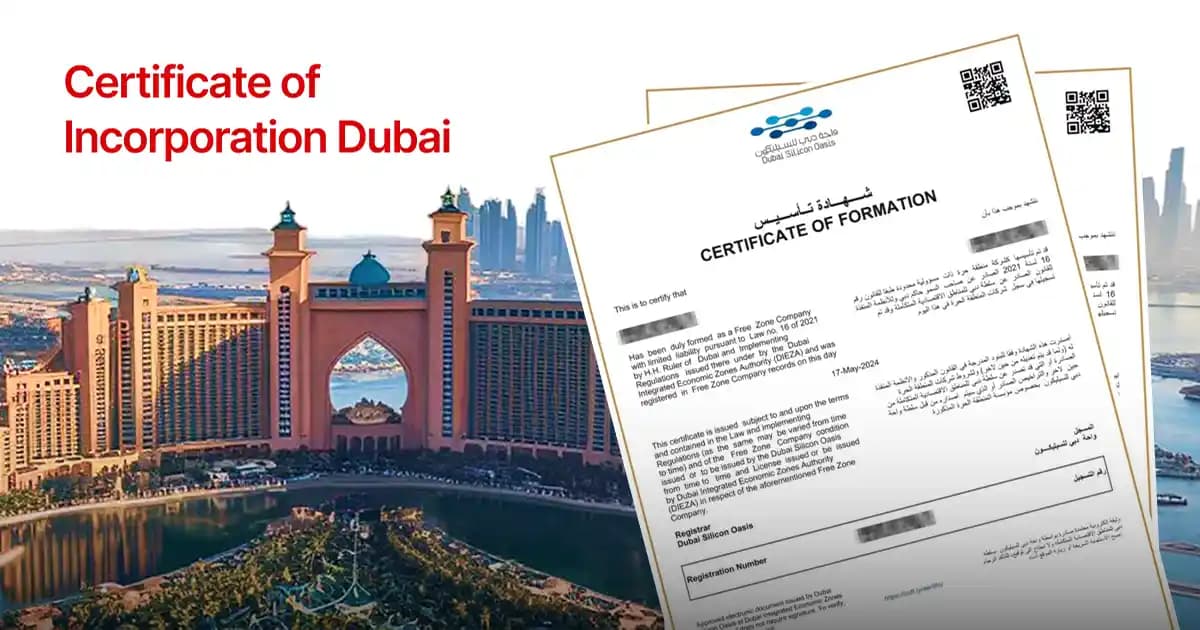
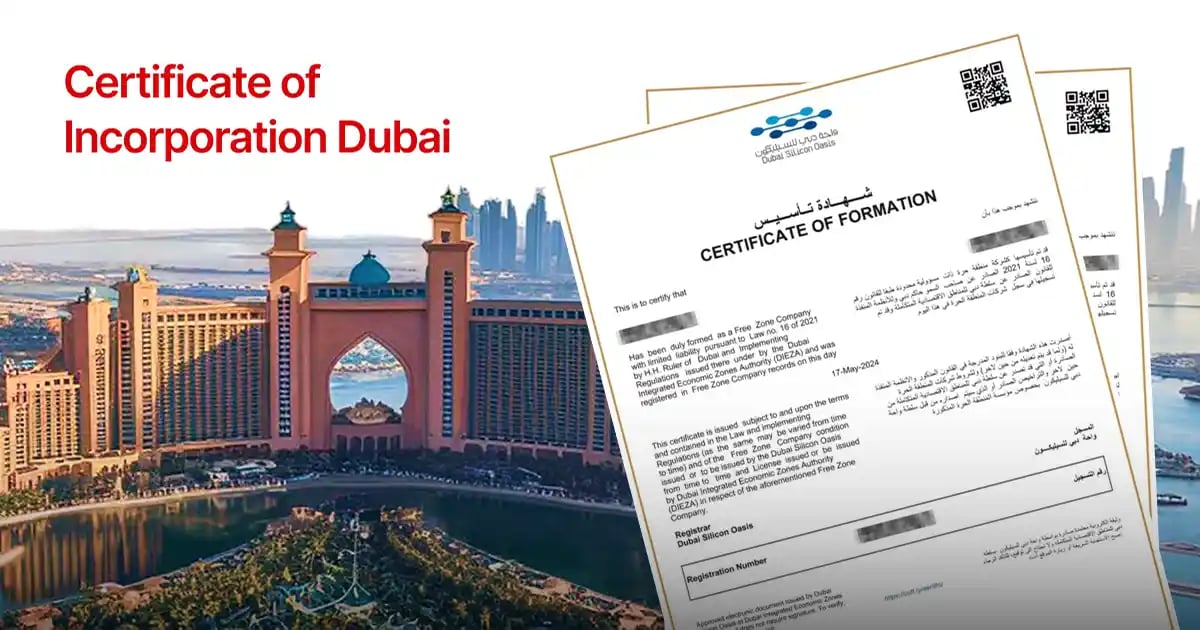
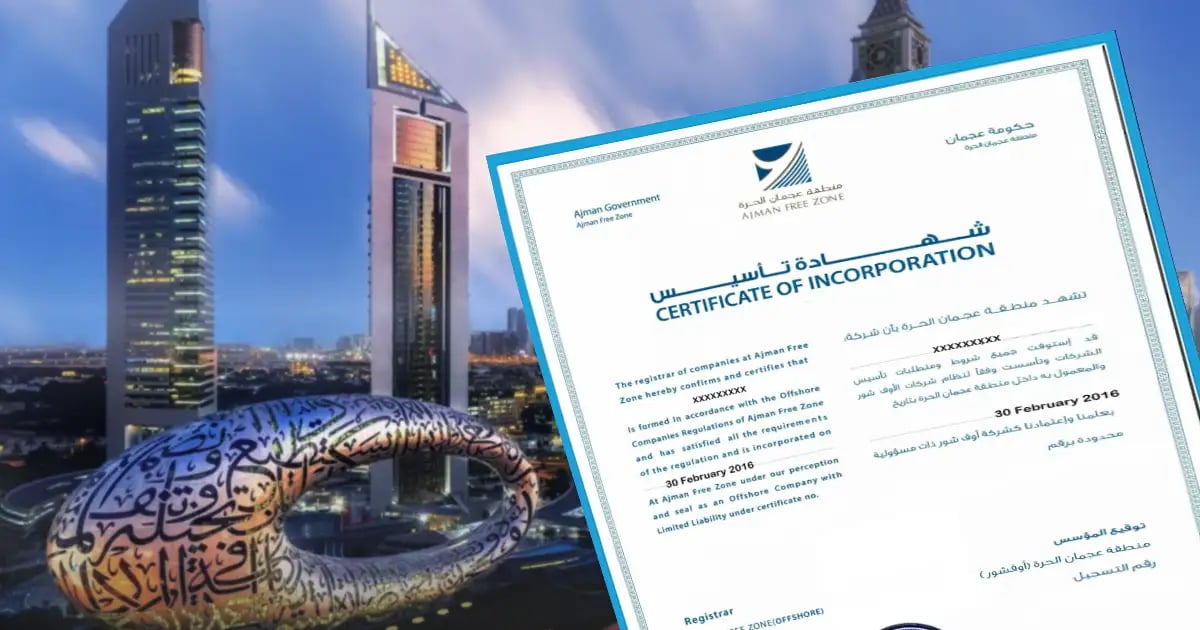
A Certificate of Incorporation in Dubai is an official document issued by a UAE authority confirming legal company formation. It proves that the business exists as a separate legal entity with its own rights, liabilities, and obligations under UAE law.

The Department of Economy and Tourism and the relevant Free Zone authorities issue the Certificate of Incorporation in Dubai after completing approvals and verifying documents. The issuing authority depends on the jurisdiction, including the Mainland, Free Zone, or offshore company structures chosen during business setup.

Contrary to normal disbelief, the Certificate of Incorporation in Dubai differs from a trade license because both documents serve separate legal and operational purposes. The certificate confirms company formation, while the trade license allows businesses to conduct approved commercial activities legally in Dubai.

Why Certificate of Incorporation in Dubai is Important?

The Certificate of Incorporation serves as the foundation of business operations and legal recognition in the UAE market. It:

  • Allows companies to open corporate bank accounts with banks for business transactions.
  • Helps businesses sign contracts with clients, suppliers, and government authorities legally.
  • Enables investors to verify company legitimacy before making any financial or strategic investments.
  • Supports VAT registration and other tax compliance processes under the UAE Federal Tax Authority regulations.

Without this document, no company can operate legally or establish trust with stakeholders in Dubai.

Who Issues the Certificate of Incorporation in Dubai?

The issuing authority for a Dubai Certificate of Incorporation depends on the jurisdiction chosen for business setup:

Mainland Companies

The Department of Economy and Tourism (DET) registers Mainland companies in Dubai, replacing the former Department of Economic Development (DED). The DET issues the Certificate of Incorporation and the trade license to all Mainland businesses in Dubai. Mainland companies can operate across the UAE, trade directly with local markets, and participate in government tenders. Mainland companies can operate anywhere across the UAE, trade directly with the local market, and bid for government contracts.

Free Zone Companies

Each Free Zone in Dubai has its own governing authority, and that authority issues the Certificate of Incorporation for companies registered within it. For example:

  • DMCC (Dubai Multi Commodities Centre) issues its own incorporation certificate for companies in Jumeirah Lakes Towers.
  • IFZA (International Free Zone Authority) issues certificates for companies registered within its jurisdiction.
  • JAFZA (Jebel Ali Free Zone Authority) issues certificates for companies in the Jebel Ali Free Zone.
  • DIFC (Dubai International Financial Centre) issues certificates through its own registrar.

Offshore Companies

Offshore companies registered through jurisdictions such as JAFZA Offshore or RAK ICC receive a Certificate of Incorporation confirming their registration. However, offshore companies cannot operate within the UAE Mainland, cannot hire staff under a UAE visa, and cannot lease a physical office in the UAE. Their certificates are used primarily for asset holding, international trading, and corporate structuring purposes.

What Does a Dubai Certificate of Incorporation (COI) Contain?

Although the exact format varies slightly between authorities, a standard Certificate of Incorporation in Dubai contains the following information:

  • Company name as officially registered
  • Registration number or company identification number
  • Date of incorporation (the official formation date)
  • Legal form of the company, for example, Limited Liability Company (LLC), Free Zone Establishment (FZE), Free Zone Company (FZCO), or Branch
  • Approved business activities the company is authorised to conduct
  • Registered office address
  • Share capital amount and distribution
  • Names of shareholders and directors
  • Company duration, either perpetual or fixed term
  • Official stamp and signature of the issuing authority

How to Verify a Certificate of Incorporation in Dubai

You can verify a Certificate of Incorporation in Dubai directly through the issuing authority. For Mainland companies, use the Department of Economy and Tourism (DET) online portal (dubaidet.gov.ae) and enter the company registration number.

For Free Zone companies, use the respective Free Zone authority’s verification portal, such as DMCC, JAFZA, DIFC, or IFZA, to confirm certificate authenticity. Verification ensures the company is legally registered, confirms registration details, and validates the certificate for official, banking, and contractual purposes. Many Free Zones include QR codes or digital barcodes on certificates for instant online verification.

How to Get a Certificate of Incorporation in Dubai? Step-by-Step Process

The process to apply for a Certificate of Incorporation in Dubai proceeds the same way for Mainland, Free Zone, or offshore companies. The specific forms, fees, and timelines vary by authority.

Step 1: Choose Business Activity

Define your Dubai business activity accurately, as it determines approvals, jurisdiction, and applicable rules. Wrong activities cause costly future amendments.

Step 2: Select Jurisdiction — Mainland, Free Zone, or Offshore

Selecting the correct jurisdiction is critical. Companies opting for business setup in the UAE Mainland can operate throughout the UAE and bid for government contracts.

Meanwhile, businesses performing business setup in UAE Free Zones enjoy benefits like 100% foreign ownership and streamlined regulatory processes.

Entrepreneurs choosing a business setup in the UAE Offshore focus on international trade and investment without the need for a physical UAE office.

Foreign nationals can learn how to set up a company in Dubai, understand ownership rules, and explore visa options. Read our detailed guide on “How to Register a Business in Dubai as a Foreigner.”

Step 3: Reserve a Trade Name

The company name must be unique, follow UAE naming conventions, and be approved by the relevant authority. Trade name reservation is done through the DET portal (Invest in Dubai) for Mainland companies and through the respective Free Zone portal for Free Zone companies.

Note: Names cannot include offensive language, cannot reference religions inappropriately, and must not already be registered by another entity.

For a complete guide on protecting and registering your brand name in the UAE, read this detailed blog: How to Register a Brand Name in UAE?

Step 4: Obtain Initial Approval

Apply for preliminary approval, confirming authorities have no objection to your activity and ownership. Regulated sectors require additional approvals from the Ministry of Health, Central Bank, KHDA, or Dubai Municipality.

Step 5: Prepare and Notarise the MOA and AOA

The Memorandum of Association (MOA) defines the company’s ownership structure, share capital, and purpose. The Articles of Association (AOA) define internal governance rules.

Step 6: Secure Office Space

Every jurisdiction requires evidence of a registered address:

  • Mainland companies: A physical office with a valid Ejari tenancy contract registered with RERA is mandatory.
  • Free zone companies: Flexi-desk, virtual office, or serviced office options are available through the Free Zone authority.
  • Offshore companies: No physical office is required in the UAE.

Office size also affects the number of employee visas the company can apply for. Most Free Zones issue one to two visas per flexi-desk and more for larger office spaces.

Step 7: Submit Documents and Pay Government Fees

Submit all required documents to the relevant authority to complete the registration process in Dubai. Submit:

  • MOA, initial approval, and trade name certificate
  • Provide passport copies of shareholders and directors
  • Attach the office lease or Ejari
  • Include activity-specific approvals

The authority reviews the application and issues the Certificate of Incorporation along with the trade license.

Step 8: Receive the Certificate of Incorporation

Once all requirements are met and fees are cleared, the authority issues the Certificate of Incorporation. In many Free Zones, the document is delivered digitally with a QR code or barcode that can be verified online. Some authorities still issue hard copies.

The timeline for getting a Certificate of Incorporation in Dubai ranges from 1 to 4 weeks.

Cost Charged to Apply for Certificate of Incorporation in Dubai (2026 Breakdown)

The average cost for getting a Certificate of Incorporation in Dubai ranges from AED 10,000 to AED 80,000, depending on jurisdiction and setup requirements. The Certificate of Incorporation does not carry a separate fee. It is part of the overall company registration cost, which includes the trade license fee, name reservation, MOA notarization, and office lease.

Here is the cost breakdown:

ComponentMainland (Dubai)Free Zone
Trade license and registration fee AED 12,000 to AED 25,000+ AED 6,000 to AED 20,000 (varies by zone and package)
Trade name reservation AED 620 to AED 2,000 Included in most Free Zone packages
MOA notarisation AED 1,500 to AED 3,000 Usually, a fixed Free Zone fee
Office lease (Ejari/flexi-desk) AED 10,000 to AED 80,000+ per year AED 5,000 to AED 25,000 per year for flexi-desk
PRO and document processing AED 2,000 to AED 5,000 AED 1,000 to AED 3,000
Visa (per person) AED 3,000 to AED 7,500 AED 3,000 to AED 7,500
Total first-year estimate AED 25,000 to AED 80,000+ AED 10,000 to AED 35,000

VAT Registration and the Certificate of Incorporation

Once a company receives its Certificate of Incorporation in Dubai, the next major compliance step is VAT registration with the Federal Tax Authority (FTA). VAT at 5% applies to most goods and services in the UAE.

  • Mandatory VAT registration: Required when annual taxable supplies exceed AED 375,000.
  • Voluntary VAT registration: Available when taxable supplies or eligible business expenses exceed AED 187,500.

For startups with zero revenue, voluntary VAT registration is beneficial because it allows the company to reclaim VAT paid on incorporation costs, office rent, equipment, and other business expenses. The FTA processes VAT registration applications online through the EmaraTax portal, and the Tax Registration Number (TRN) is issued digitally.

For Free Zone companies in Designated Zones such as JAFZA or DAFZA, specific VAT rules apply. Goods moving between designated zones are treated as outside the scope of UAE VAT. However, if these companies provide services or sell goods to the Mainland and their taxable turnover exceeds AED 375,000, VAT registration becomes mandatory.

Common Mistakes to Avoid When Getting a Certificate of Incorporation in Dubai

Most delays and rejections in the incorporation process arise from these avoidable errors:

Common MistakeExplanationSolution
Choosing the wrong jurisdiction A Free Zone company cannot sell directly to UAE retail customers, limiting operations. Select Mainland registration from the start for direct UAE market access.
Selecting incorrect business activities Authorities approve specific activity codes; unrelated or missing activities cause compliance issues. Choose activities that match actual operations and obtain approval for all intended functions.
Document inconsistencies Mismatched names on passports, MOA, or registered address cause application rejection. Ensure all documents are consistent and accurate before submission.
Not securing the office before the application DET requires a signed Ejari contract for Mainland companies; missing it delays processing. Arrange a valid office and register Ejari before filing for the certificate.
Assuming COI covers all approvals Some sectors need additional regulator approvals; COI alone does not authorise operations. Obtain all sector-specific approvals in addition to the Certificate of Incorporation.
Ignoring annual trade license renewal Expired trade licenses block visas, ROC filings, and banking operations. Renew the trade license every year to maintain compliance and operational continuity.

Certificate of Incorporation vs Trade License in Dubai

Many business owners in Dubai confuse these two documents. However, they serve different purposes and are not interchangeable:

FeatureCertificate of IncorporationTrade License
Purpose Confirms the legal formation and existence of the company Grants permission to conduct specific business activities
What it proves The company is a registered legal entity The company is authorised to operate commercially
Validity Does not expire (permanent as long as the company exists) Must be renewed annually
Issued by DET (Mainland) or relevant Free Zone authority DET (Mainland) or relevant Free Zone authority
Required for Bank account opening, contracts, and investor due diligence Day-to-day operations, employee visas, import/export

How SafeLedger Helps with Certificate of Incorporation in Dubai?

SafeLedger simplifies company incorporation in Dubai, ensuring a smooth, error-free process:

  • Evaluates the correct jurisdiction based on business activity and ownership goals.
  • Reserves trade names and prepares all corporate documents accurately.
  • Coordinates activity-specific approvals and manages office registration.
  • Submits the complete application to DET or the relevant Free Zone authority.
  • Supports Mainland, Free Zone, and Offshore structures from start to certificate issuance.

SafeLedger handles every step efficiently, helping businesses obtain the Certificate of Incorporation quickly and correctly. Contact us today!

Frequently Asked Questions

A certificate of incorporation in Dubai is an official document issued by the Department of Economy and Tourism or a free zone authority. It confirms that a company is legally registered under UAE law and serves as the business’s legal identity for bank accounts, visa processing, contracts, and investor verification.

Free zone companies typically receive the certificate in 5 to 10 working days, while express options can take 1 to 3 days. Mainland Dubai companies usually take 2 to 4 weeks due to Ejari registration, DET processing, and activity-specific approvals. Offshore company setups can often be completed remotely within 5 to 7 working days.

No, the certificate of incorporation confirms legal formation, while the trade license grants permission for commercial activities. Free zones issue them separately, whereas on the mainland, they are issued together but remain legally distinct. The certificate does not expire, but the trade license must be renewed annually to maintain business operations.

Yes, foreign nationals can fully own companies in Dubai. Free zones have always allowed 100% foreign ownership. Mainland companies now also permit 100% foreign ownership in most sectors under the UAE Commercial Companies Law amendment, removing the previous requirement for a local partner. This enables international investors to operate with full legal control.

No, the certificate of incorporation remains valid as long as the company is registered and legally active. However, the trade license issued alongside it must be renewed every year. An expired trade license prevents the company from legally operating, renewing visas, or conducting banking transactions, even though the certificate itself stays technically valid.

Yes, companies must provide their certificate of incorporation, trade license, MOA, and supporting documents to the Federal Tax Authority when registering for VAT. The certificate confirms legal existence and company registration details, which the FTA uses to verify the business before issuing a Tax Registration Number for compliance under UAE VAT law.

To obtain the certificate, companies must submit MOA, initial approval, trade name reservation certificate, passport copies of shareholders and directors, and office lease or Ejari. For regulated sectors, additional approvals from authorities like the Ministry of Health or Dubai Municipality are required. Submitting accurate and consistent documents ensures faster processing and avoids application rejection.

No, a company cannot legally operate without a certificate of incorporation in Dubai. Banks, government authorities, and clients require the document for business contracts, visa processing, and financial transactions. Attempting operations without it may lead to legal penalties, fines, and operational restrictions, making the certificate mandatory before starting any commercial activity.

The chosen jurisdiction, Mainland, Free Zone, or Offshore, affects processing time, ownership rules, and operational restrictions. Mainland companies can trade anywhere in the UAE, Free Zones focus on international operations, and Offshore setups cannot operate locally. Each authority has unique requirements, and selecting the correct jurisdiction ensures compliance with UAE law and smooth incorporation.

Common mistakes include choosing the wrong jurisdiction, selecting incorrect business activities, submitting inconsistent documents, applying without a valid office, assuming regulatory approvals are covered, and ignoring trade license renewal. Avoiding these errors ensures timely issuance, reduces additional costs, and prevents legal or operational complications during and after the incorporation process.

WhatsApp Icon